
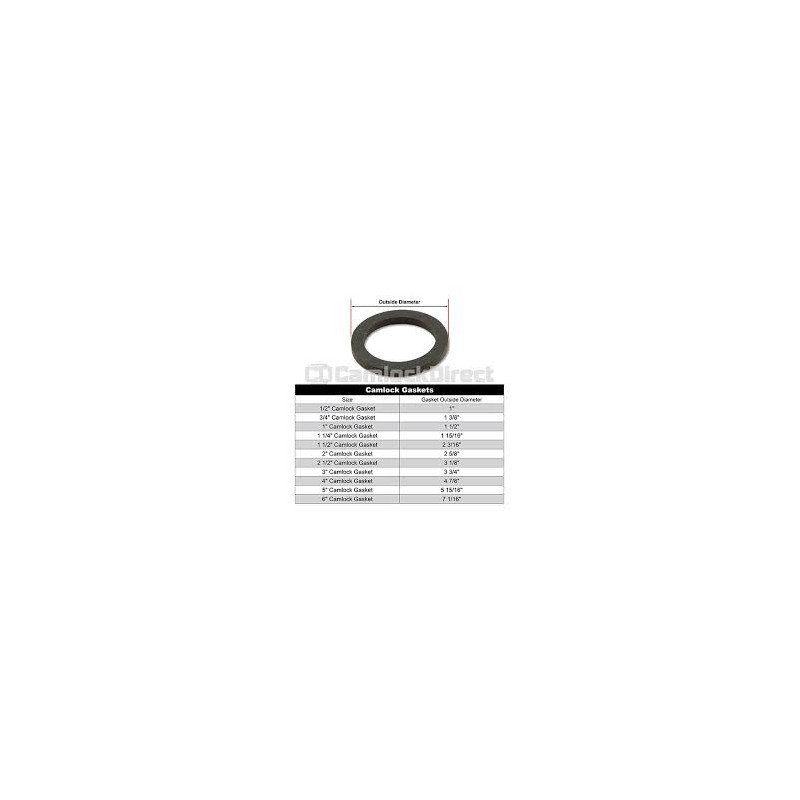


Camlock 1" Replacement Gasket
 Sécurité
La sécurité de votre commande dependra de votre mode de livraison
 Livraison
La livraison du prdotui par Allmann Group sera entre 2 à 4 jours
 Retour d'article
Au delais d'un delais de 10 jours, les articles ne peuvent plus être retournés après utilisation
These Buna-N gaskets for female cam and groove couplings.
NITRILE (NBR, Buna-N): Acrylonitrile-butadiene
Trade Names
Advantages
Very good resistance to oil and gasoline; superior resistance to petroleum-based hydraulic fluids; wide range of service temperatures (-65° to 300° F); good resistance to hydrocarbon solvents; very good resistance to alkalis and acids.
Limitations
Inferior resistance to ozone, sunlight, and natural aging; poor resistance to oxygenated solvents.
Remarks
Nitrile and neoprene are the highest-volume oil-resistant elastomers. Nitrile is superior to neoprene in resistance to oil, gasoline, and aromatic solvents. However, it does not perform as well as neoprene in applications requiring exposure to weather, ozone, and sunlight. Furthermore, it has no inherent flame resistance.
The properties of nitrile vary considerably with the ratio of acrylonitrile and butadiene. In general, as the acrylonitrile content of the elastomer increases, oil and solvent resistance and abrasion resistance improve. When the acrylonitrile content decreases, these properties deteriorate, and low-temperature flexibility and resilience improve.When nitrile is modified by polyvinyl chloride (PVC) resins, its resistance to weather, ozone, and sunlight improves considerably without significant sacrifice in oil-resisting properties. PVC/nitrile is similar to neoprene, in general, however, it is much inferior to neoprene in adhesion to fabrics and metals.
Carboxylated nitrile is generally tougher and more resistant to tear and abrasion than conventional nitrile, but it is less resilient and flexible at low temperatures.
Camlock 1" Replacement Gasket